Wednesday, 4 July 2012

Camera Shots and Compositions


In order to create a succesul sequence, it is important to pick the right kind of shot, not only the framing but the subtle language it creates. There are certain reasons why directors choose to use certain shots. Below are some examples of some shots and why directors might use them...

  • Extreme Close Up- This shot only shows part of a head or body or thing. These shots are often used to show emotional scenes as these increase dramatic effect.
  • Close Up- This frames something but not in as much detail as an extreme close up. This shot also conveys reactions and emotions. The best part of these shots is that they focus the audience on one thing and one thing only.
  • Medium Shot- Shows the character once again. These shots are used to show interaction between characters.
  • Long Shot- Shows the character at a distance. This often puts the characters in their surroundings and adds context to a shot.
  • Establishing Shot- This orientates the scene.
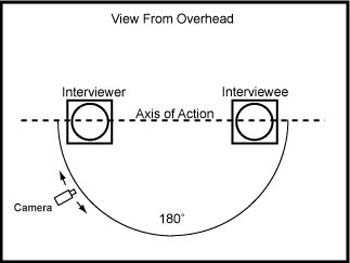
Another thing that directors must consider is how the audience will see the scene. One rule that producers must stick to is The 180 degree rule. This says that two characters should have the same on screen relationship.


The camera is only allowed to travel along the 180 degree line otherwise the audience would get confused.  Often shots such as over the shoulder shots are used to help the audience follow the action.

Tuesday, 3 July 2012

Stages to be Successul (The Script)

Another key element to making a successful production is a script. A script is vitally important as this gives everyone involved a narrative. The script doesn't have to feature dialogue but it features stage directions and shot compositions too.


An example script from The Ring.


This is a link to the scripts finished production. As you can see, the director used the script as a rough outline and didn't stick to it religiously. This suggests that the action the director shot was more usful but without the script they wouldn't have known to shoot anything.


Below is our finished script. We took inspiration from our storyboard and our idea to create a finished piece.

Stages to be Successful( Storyboard)


Storyboards are visualisations of the script. Cast and Crew use these so that there is no confusion.
A storyboard is a graphical representation of the camera shots in a film sequence which are connected together to create a narrative. The narrative of each sequence is visualised by a series of drawings which depict location, character, props and setting if each shot. Images in the shot are accompanied by text detailing the action, camera directions, lighting directions and sometimes basic dialogue.

They are used so that the narrative will flow and create a story for the audience. They are used as the basis of discussion between director and the director of photography to decide how shots need to be acted, lit and shot.

Here is an example storyboard from The Lord of The Rings. The storyboard shows how each scene should be shot.


We took inspiration from this to create our own storyboard. Here is the first basic one we made as a group.


This is a basic example as it lacks any technical detail. The example below shows the technical aspects of the scene. It features more explicit vocabulary which helps cast and crew. Even if the storyboard is basic it still proves useful.


Stages to be succesful( Mind Map)

There are three stages in making a video:
  • Planning- Medium length stage.
  • Production- Short length stage.
  • Post-Production- Long length stage.

Planning

We decided that our group name would be JKC Productions.

First, you need an idea. My group and I discussed situations in which people would exchange lines of dialogue. We then mind-mapped these and weighed up the pro's and con's of each situation.


Here is a list of what is featured on the mind map:
  • A couple in a bar- One character sits next to another and a romantic ambience is created.
  • Two classmates sist next to each other and discuss their weekend.
  • An interview betwen an employer and potential client takes plac.
  • A Doctors surgery where bad news is broken to a patient.
  • A police officer and detective interview a suspect.
  • A family sit down to an evening meal and discuss their day.
  • Two characters sit and flirt whilst on a bus.
  • A teacher calls a student to talk about missing lessons and not doing homework.

The Mind Map


Preliminary Video Task Brief

"Film and Edit a sequence in which:
  • A character opens a door, crosses a room and sits down in a chair opposite another character, with whom she/he then exchanges a couple of lines of dialogue.
  • This task should demonstrate match on action, shot/reverse shot and the 180-degree rule.
  • Try and make this interesting!"

Welcome to A2!

I have chosen to carry on with next years course!

Bring it on! :)