Wednesday, 4 July 2012

Camera Shots and Compositions


In order to create a succesul sequence, it is important to pick the right kind of shot, not only the framing but the subtle language it creates. There are certain reasons why directors choose to use certain shots. Below are some examples of some shots and why directors might use them...

  • Extreme Close Up- This shot only shows part of a head or body or thing. These shots are often used to show emotional scenes as these increase dramatic effect.
  • Close Up- This frames something but not in as much detail as an extreme close up. This shot also conveys reactions and emotions. The best part of these shots is that they focus the audience on one thing and one thing only.
  • Medium Shot- Shows the character once again. These shots are used to show interaction between characters.
  • Long Shot- Shows the character at a distance. This often puts the characters in their surroundings and adds context to a shot.
  • Establishing Shot- This orientates the scene.
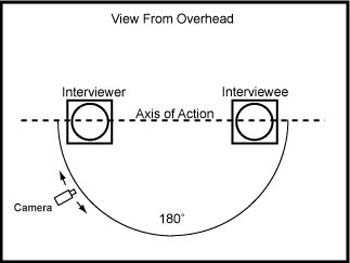
Another thing that directors must consider is how the audience will see the scene. One rule that producers must stick to is The 180 degree rule. This says that two characters should have the same on screen relationship.


The camera is only allowed to travel along the 180 degree line otherwise the audience would get confused.  Often shots such as over the shoulder shots are used to help the audience follow the action.

Tuesday, 3 July 2012

Stages to be Successul (The Script)

Another key element to making a successful production is a script. A script is vitally important as this gives everyone involved a narrative. The script doesn't have to feature dialogue but it features stage directions and shot compositions too.


An example script from The Ring.


This is a link to the scripts finished production. As you can see, the director used the script as a rough outline and didn't stick to it religiously. This suggests that the action the director shot was more usful but without the script they wouldn't have known to shoot anything.


Below is our finished script. We took inspiration from our storyboard and our idea to create a finished piece.

Stages to be Successful( Storyboard)


Storyboards are visualisations of the script. Cast and Crew use these so that there is no confusion.
A storyboard is a graphical representation of the camera shots in a film sequence which are connected together to create a narrative. The narrative of each sequence is visualised by a series of drawings which depict location, character, props and setting if each shot. Images in the shot are accompanied by text detailing the action, camera directions, lighting directions and sometimes basic dialogue.

They are used so that the narrative will flow and create a story for the audience. They are used as the basis of discussion between director and the director of photography to decide how shots need to be acted, lit and shot.

Here is an example storyboard from The Lord of The Rings. The storyboard shows how each scene should be shot.


We took inspiration from this to create our own storyboard. Here is the first basic one we made as a group.


This is a basic example as it lacks any technical detail. The example below shows the technical aspects of the scene. It features more explicit vocabulary which helps cast and crew. Even if the storyboard is basic it still proves useful.


Stages to be succesful( Mind Map)

There are three stages in making a video:
  • Planning- Medium length stage.
  • Production- Short length stage.
  • Post-Production- Long length stage.

Planning

We decided that our group name would be JKC Productions.

First, you need an idea. My group and I discussed situations in which people would exchange lines of dialogue. We then mind-mapped these and weighed up the pro's and con's of each situation.


Here is a list of what is featured on the mind map:
  • A couple in a bar- One character sits next to another and a romantic ambience is created.
  • Two classmates sist next to each other and discuss their weekend.
  • An interview betwen an employer and potential client takes plac.
  • A Doctors surgery where bad news is broken to a patient.
  • A police officer and detective interview a suspect.
  • A family sit down to an evening meal and discuss their day.
  • Two characters sit and flirt whilst on a bus.
  • A teacher calls a student to talk about missing lessons and not doing homework.

The Mind Map


Preliminary Video Task Brief

"Film and Edit a sequence in which:
  • A character opens a door, crosses a room and sits down in a chair opposite another character, with whom she/he then exchanges a couple of lines of dialogue.
  • This task should demonstrate match on action, shot/reverse shot and the 180-degree rule.
  • Try and make this interesting!"

Welcome to A2!

I have chosen to carry on with next years course!

Bring it on! :)

Saturday, 14 April 2012

Double Page Spread Evaluation


My Double Page Spread appeals to my target audience (15-24) because:
  • The artist is of a similiar age so this is effective for getting an audience as they aspire to be her or be with her.
  • The language in the text is basic and not sophisticated. It is an easy read and quite easy to follow.
  • The topic of the talk is quite chatty and relatable.
  • The text is colourful and bright so it attracts the attention of the reader.
My Double Page Spread features the following conventions:
  • A title so the reader knows what the article is about.
  •  A puff showing that the magazine loves the featured artist.
  • A personal close image that readers can associate with.

My Double Page Spread features the following codes:
  • More than one large bit of text.
  • More than one colour to brighten things up.
  • Not using a capital letter at the beginning of the introduction.
  • A long introduction so the reader can get a feel for the audience.

If I were to redo my Double Page Spread, I would:
  • Use a clearer font to make the text easier to read.
  • Use a capital letter at the beginning of my paragraph to make it clearer.
  • Use more images to create a montage of the artist.
  • Make the important bits stand out more.
  • Write more for the article and less for the introduction.
  •  

Double Page Spread Final

Tuesday, 27 March 2012

Contents

Final Final Final Contents Page

This is my final contents for my music magazine. Below are the stages I went through to produce my contents page.


My Contents appeals to my target audience (15-24) because:
  • The contents are easy to read, simple layout and has a nice visual pattern.
  • The artist on the cover is smiling and therefore easy to connect with.
  • It is similiar to Q.
  • It is clear to understand.
My Contents features the following conventions:
  • Page numbers that help the audience find the page or segment they are looking for.
  • A header that tells the audience which page they are on.
  • An orderly column which is split in to two that helps the audience locate the article they want.
  • One big image and a smaller little one.
My Magazine features the following codes:
  • A slightly off centre image which draws attention to the tag line.
  • Alternating colours that allow the audience to search easily.
  • Just a page number on top of the image as the audience will know the cover star already.
  • A red,white and black colour scheme (like Q)
If I were to re-do my Contents I would:
  • Move the tag line to the front cover.
  • Feature more images.
  • Use more text and font and graphics.
  • Make things look livlier.
  • Use the same font and text to allow the audience to become familiar with a style.

Final Final Final Front Cover (Step by Step)

This is my final cover for my music magazine. Below are the step by step stages that I have done in order to make my magazine and some covers I chose not to continue with.


 This is one of the covers I chose to not continue with. I changed the title from my original design as the other one was too edgy and did not encorporate the theme I wanted to obtain. I chose this one was it suggests formality but looks visually effective at the same time.

For the image itself, I used a better camera than the one I had previously used. This is because the quality of this image is better than the ones I used before (see left). I have chosen to use another girl on my front cover as the girl on the right was easier to photograph. I chose to use the other girl as although she is pretty like the other girl, she has a more music magazine look. She looks older and maturer and this helps it to look like a music magazine project and not like a college project. The image itself is quite plain and boring but the quality is good.


Here is another cover I have chosen not to develop. The reason for this is that the text looks immature and not proffesional. The red stands out too much for the background of the image as well. I feel the cover is far too busy as well despite the lack of much on it. The cover does not follow a theme too. It just happens to be lots of different things that do not co-ordinate on the cover. The title in the top corner does not fit in with the fact that she is surrounded by nature as well. The image itself would work better as an advert or a single page spread and not as a double page spread. I like the fact that she looks scared. This creates a common feeling amongst reader and star as they feel as if they can relate to the artist.


Below is the evaluation of my final front cover and an image of my final front cover. I will discuss how it relates to my target audience and how I could improve it.


Target Audience:

My Magazine appeals to my audience (15-24) because:
  • It uses a model/artist that is of a similiar age to the audience.
  • The colour scheme is basic and therefore the audience does not caught up in looking at graphics. My audience just want to read a good magazine with quality content.
  • The other featured artists are typical of "mainsteam" teenagers music tastes.
  • The magazine is new and fresh and this appeals to the teenagers who want a brand new yet up to date magazine that no one else has.
  • The image is plain and simple and this makes the artist relatable to the audience.
My Magaine features the following conventions:
  • It has a barcode (used to scan for pricing).
  • It features an issue date.
  • It has several different puffs which are used to catch the audiences eye.
  • It has a title.
  • It shows the featured artist on the cover.
  • It has a body shot of the artist.
  • It has an obvious house style.
My Magazine features the following codes:
  • The artist isn't looking at the camera.
  • It doesn't feature a price.
  • The font is formal yet appeals to teenagers.
  • It doesn't feature a website title at the top of the page.
If I were to re-do my magazine, I would :

  • Add in a price or make the magazine free as the current economic climate means that magazines aren't being bought as they used to be.
  • Include a website where the people who buy the magazine can access more content online.
  • I would make the image stand out a lot more as although it is clear , it isn't the most obvious picture.
  • Not include the "35 Epic Guitar Faces" Puff as it doesn't work with the target audience.


Monday, 5 March 2012

Plan for Photo-shoot 3

Glamour vs. Grime

The idea for my next Photo-shoot was to develop the idea of a beautiful girl and have them in a grimey location. I chose this idea as the theme of pin-up girls wouldn't appeal to a wide audience or my target audience (17-24) so I decided to involve it sneakily. My model would wear a dress and would be stereotypically beautiful.  There would be bright colours to contrast with the background.


Marylin Monroe

I will take inspiration from people like Marylin Monroe as she was the ultimate pin-up girl yet fashionable. As a strong, independent and successful woman, the featured artist would have connotations of being sexy and successful. The hair Marylin Monroe had was short and beautiful and this would be a big contrast to typical pin-up girls as they often have long hair. The signature red lips will stand out in my photo to emphasise femininity and also have connotations of sex, danger and fun.


Location

The location of the shoot will be grimey and horrible and just look wrecked. This would be mocking the music industry as it would show the nasty side of the music industry and how its crumbling down around them. I will chose a location where things look a little broken and then place my model within it to show Hope in a broken industry.


Thursday, 1 March 2012

Why our coursework is pointless!

Our coursework in pointless....

According to a post by The Guardian, every magazine in the music magazine in the sector reported a decline in sales. These figures show that the music magazine industry is going in to decline. This is because of the way we can now recieve Media, for free, over the internet. All the things that we'd get from a Music Magazine can now be accessed with a few clicks of a mouse and for free. 

Music magazines now have websites which offer the same content without spending a fortune. This is unfortunate for the music magazine industry as jobs will be lost, profits will decrease and the music magazine will cease to exisist.

It's similiar to a ricochet effect too as it will start with the magazine industry and then lead to the music industry. Now, people can recieve music via iTunes, streaming and downloading illegally and no-one is buying hard copies of music anymore. This is a big problem as artists will not make music if it's not making money.

Thursday, 23 February 2012

Double Page Spread Articles

Double page spreads tend to have a few codes and conventions.

Codes
  • The beginning of the article begins with a captial letter. The letter is usually in a diferent font as well , this catches the readers attention and shows them where the article starts. (Shown by the red "M" on the image to the side)
  • There are different colour fonts and the things that stick out tend to be in the brightest colours.
  • The colour scheme reflects the housr style.
  • There are usually multiple pictures to show the status of the artist.
  • They are eye-catching, funky and the text is always written in a chatty style.
  • Words and verbs are often joint together.

Layouts of Cover

Below are the layouts I designed for my cover, contents and double page spread. I used layouts to help me establish what I wanted my magazine design to look like. I also took inspiration from other magazines. I chose to try and include a house style running through the magazine.


COVER

The Title
The title stands out at the top and is the brand name. The reason it stands out is to attract the readers eye. Fans of the magazine will know that the title is always in the top corner, this is a code of Q magazine.

The Image
The image is usually the first thing that the reader will see. it needs to stand out and be creative as a boring and uninteresting photo will not get the audiences attention. The image is usually the biggest thing on the page as well.

The Subtitles/Callouts

 The subtitles tend to circulate around the central image. This is so that when the readers look at the image, they see the other little stories that are included in the magazine. These are effective as the reader may see something they like the look off.

The Style

This style is relevant to my target audience as they are mainstream and Q magazine is mainstream as well.  The barcode is in the bottom corner as this does not stick out.  This is the generic layout for a magazine cover as shown on the right.


The Title

Once again, the title is in the top left hand corner. It stands out against the background again. Fans will identify which magazine it is because of the title.

The Image
The two images would stand out as there are two of them. I would use two images facing back to back to show a high contrast between them like the page on the right.
The Subtitles/Callouts
In this magazine, the text would be at the bottom of the page. This way, the image does all of the attracting. Its effective but it would be easier to just put the text around the image.
                                                       The Style
The style is typical of gossip magazines, not music magazines. The music is usually a little more unknown or new to the scene. This kind of cover can be found in mgazines like NME.


Wednesday, 22 February 2012

Photo-shoot number 2

This is my second photo-shoot and the photos from it. There is an evaluation at the end of the powerpoint.

Update on where I am at

Recently, I have found produccing my magazine a little difficult in the sense that I am a perfectionist. I believe that my photos are too bright and tacky and this is the reason why I haven't uploaded my front cover and my contents. I think that the photos I chose and the colour scheme aren't working right now and so therefore need little adjustments. To prove that I have been working hard, below are the cover and the contents I would have submitted had it not been for a quick self assesment on my part. I am going to take more photos and develop my skills a little more but in the mean time, I will continue to post about my expectations and research in to the development of magazines. I will continue with the theme of pin up girls but shoot it proffesionally. Portrait shots don't work unless they are interesting and this will be the next theme of my photoshoot. I am about to upload a photoshoot (Photoshoot 2) that I did but none of the pictures will work for a cover or contents or double page spread.


This is my cover so far.
As you can see the brightness of the photo makes it stand out far too much. It looks as if it has been drawn and not photographed. Though it ties in with my theme, it does not make sense to continue on with the image. The brightness also washes out the models skin which makes her look fake and doesn't tie in well with the theme of pin up girls. The pin up girl theme encourages girls to bear all with no fakery and this image is too fake for a cover. The fact that she looks like she has been coloured in doesn't work and this is the fault of the filter and my poor decision making skills. The gradual darkening of the grey background also makes the image look washed out which doesn't help the model on the cover. Originally, the image was meant to wow and catch the readers eye but it is horrible to look at.

Though the image was high quality, it looks as if it has been taken in a rush. Although it is quite like Q magazine, the house style doesn't work well with the grey background. The house style of the magazine also contrasts with the brightness of the red outfit. This makes it look cheap and tacky.

The puffs stand out well but lack a certain "Wow" factor. The colour ties in welll but the ideal colour for a magazine background is white, therefore, once the background is white, the puffs will stand out. The main title works well with layering and this is typical of average mainstream magazines.

Another problem is the title. It doesn't have a set audience and it looks out of place with the style. The name also sounds a bit weird and as if it doesn't quite fit though its too late to change the name, I could always change the font of it which may help to target and grab my audiences attention. The fact that all the text seems to be in different fonts has connotations of someone who is just getting to grips with a computer and not an A level media student.

Though this has been produced with hard work and determination, I feel I can do better. I now have more skills and more points to reflect on in order to make a decent looking cover. I know I should have moved on to the double page spread by now but I feel that my best outcome hasn't quite come out yet. In order to create a better magazine, I will :
  • Do at least three more photo shoots with different models, settings and themes and choose the best photos out of them.
  • Create a layout of my pages and explain why I have chosen to do this.
  • Explain why I have chosen a certain theme and aim and how this will affect my audience.
  • Work on every little detail and put in 110%
  • BLOG ABOUT EVERYTHING!

Wednesday, 18 January 2012

Music Magazine Interview Analysis

In our lesson this week, we looked at magazine interviews.

They all involved the same artist and we had to identify the codes and conventions of each page.

Some similiarities include an image featuring the artist. This might sound silly but without an image, the reader would not have any way of knowing who the article was talking about. The headlines stand out as well which catches the readers eye. Both interviews have quotes around the text box. This also grabs the readers attention as it allows them to be drawn in .  In both magazines, the interviews were split in to sections where they had the image on one side and the text on the other.

Some differences include the style its written in. One is friendly and the other is formal.  In one magazine, there is a white empty space which isn't very typical of interviews. The image also doesn't look straight at the camera whereas the other one does. In one image, she is dressed up smartly and in a dingy setting but in the other she is out and about in London, acting like she isn's famous.

Double Page Spread Research

This cover is one of my favourites. It uses bright colours within the image and catches the attention of the reader. The image is bright and creates a feeling of power. The image takes of most of the page and is the first thing you see. The text at the top is feminine and girly which boasts the style that the featured artist works in. The faded text in the background is big yet not as visible. This may be because the featured artist isn't from the USA but the image she is in shows that she supports them. The big letter D at the beginning of the paragraph is the same font used at the top which shows a  clear style. This is typical of all magazines as it uses the big letter so it draws the attention to the writing or text. The background is grey which isn't very appealing but it works within this page. The editing shows that the image is supposed to capture what the artist is about, feminine, powerful and succesful. The link between her and the USA could be that she represents Lady Liberty.

The dark colour scheme of this double page spread suggests a consistent house style. It is also reflective of the featured Band. The page is black and the image is well photographed but doesn't capture the eye of the reader. The fact that the central image isn't looking straight at the camera is unusual but it works with the style of the magazine.The fact that there is more than one image creates a personal feel to the double page spread. The use of the red and white and black fonts draw the readers attention to the text.The font at the top is quite edgy and reflects the style of the band.  Once again, the big letter at the beginning of the text draws the attention to the text. The quote at the top is the title for the piece and this attracts the attention as it is often personal or uses humour. The callout box at the side is also typical of double page spreads. It often provides the reader with more information which shows that there is a lot for their money.

This double page spread looks very busy. This is effective as the reader wants the most for their money and this page provides them with it. The image takes up the whole half of the page. This allows the reader to feel closer to the band. There are other different images on the page but this one stand out more as it is bigger and better. The band look quite casual and the setting is casual too. This gives off vibes that the band is cool and casual. The other images are action shots which show that they do exsist and that concerts and gigs are happening. The blue boxes on the pages stand out and are consistent through the whole double page spread. They draw the readers attention closer. As always, the big letter at the beginning of the main block of text is appealing the audience and consistent with the font style. The main body of text is structured well on the page as it looks nice to read. There isn't a lot of text but its in a smaller font so it appeals to the audience as there isn't a lot but its detailed.

Tuesday, 17 January 2012

Contents Pages that I like

Part of our task is to make a contents page as well as a front cover. In order to make a decent as well as proffesional looking cover, I did some research. Some criteria I am looking for include the following:
  • The lighting has to be different as bright images will capture the attention of the audience and when a potential consumer buys a magazine, they look at the contents page.
  • The image has to be unique and relfective of the cover page as I would like there to be a certain theme and this will make the magazine more proffesional as it will be linked through images, text and layout.
  • I would like there to be a level of humour or "fun" about it.


I like this contents as the image is central but interesting. It grabs the readers eye. The lighting is bright and creates a shadow which I like as it presents a level of realism and also suggests that the image has been shot recently and is therefore fresh. The fact that it seems that there has been no photoshop suggests that she is relatively "normal". The expression on her face is fun and flirty and fascinating.
The next contents I liked was this one. It is quirky and unique and this is the style I'd like to achieve. The only problem is the fact that it is quite plain. The use of different coloured texts makes the page seem very proffesional. I don't like the way that the Mushroom stands out more than the star at the bottom of the page. It could also be representing drugs and thats not the message I want to send out to my audience.
I like this cover as well as it uses different fonts and heading and this is typical of magazines as it looks as if it shouldn't look nice on the page but it does. The different colours make it look patchy yet proffesional as its the house style of the magazine. The images on the page are well taken and show that there is a lot of variety within the magazine. The text at the top of the page is different and I will not include this on my contents as it doesnt feel very music magazine.


My Media Pack

For my Media project, I created a Media pack. Media packs are released by the magazines to potential advertisers and people who want to know more about the magazine.
Magazines are funded a lot by the advertisers so making an appropriate pack which appeals to the audience.
This is my cover page, I chose to use a central image as it catches the eye of the potential advertisers. I used the title going up the side of the page as it is similiar to Mojo. I also like the dark image as it isn't plain and boring.

This is my typical reader profile. Most magazines release what they think their ideal client or reader is like and this helps them to judge what content they should put in the magazine. In my case, my reader profile is of a man called Charlie. The text reads "
Charlie is 19. He studies History at University and his passions include writing and music. He taught himself how to play guitar and whips it out at every opportunity.

His music tastes influence his lifestyle  choices  and he's always up to date with the latest chart topping bands as well as discovering new ones .He’s up to date with his work so he always has time to party through the night. On the side, he DJ’s  at a local nightclub and his favourite past time is going to gigs. He knows how to have a good time. He’s not a  likes to call his style edgy and unique and vintage and that’s what SWITCH is all about." 
I chose this chatty style as it appeals to a wide audience.                    


Wednesday, 4 January 2012

Covers so far

So far in Media, we have been making front covers. Below are some of the covers I made and my own evaluation of them. None of them are finished yet but I have drawn several ideas from each of them.


This is an image I like. I have drawn the idea of layering the main text and put that on to an image I like. I have also taken the title and emulated it as I found that it stood out. The grey background also inspired me as it isn't just plain and also doesn't wash Lady Gaga out rather it makes her stand out.
This is a cover still in the making as it is still quite plain whereas the Q cover looks busy.


I also played around with the text and the positioning of the headline. I think this looks good but I prefer the one above. I tried the text without a background and found the image on the right looks a lot better is gives the image some defenition. I took inspiration from the Lady Gaga cover by layering the text once again. The figure also looks a like more realistic too.


 I decided to play around with the backgrounds too. I found this useful as not all magazines have white backgrounds and some do. In the examples of music magazines, they tend to have a coloured background. I chose to use lots of different colours in order to find something realistic and proffesional. Below are some examples, I have chosen to use a plain white background though as none of the colours look right with my striking central image.

 The yellow is too bright. It wouldn't look right although it would stand out, the yellow though it compliments the figure contrasts against the red box


This pink appeals to females and my target audience is males
as well. It doesn't compliment any of the image.
I like this colour as its not too striking and compliments my image but once again, a coloured
background wouldn't suit.
This green goes well with the red in the image but
a coloured background wouldn't get the right kind of
connotations of denotations.

Conclusions

  • My background will be white with a tint maybe.
  • The image has to stand out and catch the attention of the reader.
  • The text will be layered over the central image as this gives it a proffesional feel.
  • The magazine will be proffesional looking and have an edge to it. 
Going red all over makes the central image seem dull
and boring and doesn't work with any of the colour
schemes.